EdgeGuardian: Edge AI Safety Bubble for Machine Monitoring
EdgeGuardian is a local monitoring prototype that combines camera-based person detection with LiDAR distance measurements and classifies the current state as SAFE, WARNING or ALERT.
Prototype only - not a certified safety system.
Role
I integrated the camera, Hailo accelerator and LiDAR, wrote the ESP32-S3 firmware in C/C++, and implemented the fusion logic, dashboard and CSV logging.
Key results
- ~30 FPS
- Demo throughput
- Local inference
- Raspberry Pi 5 + Hailo-8L
- Camera + LiDAR
- Fused sensing
- SAFE → WARNING → ALERT → SAFE
- Demonstrated state sequence
Problem and constraints
Machine areas become dangerous when a person enters the operating zone of moving parts. A cloud-only camera pipeline would add latency, privacy concerns, and network dependency, while camera-only detection cannot reliably confirm physical distance.
Security
The design keeps camera inference and safety decisions on the local edge device rather than sending video to a cloud service. Configuration examples avoid private Telegram secrets, and the dashboard reads logs without streaming camera frames.
Reliability
Confidence filtering, LiDAR stale-data protection, 3-frame ALERT hysteresis, 5-frame SAFE recovery, Telegram cooldown, and CSV event logs make the prototype more stable and explainable during a live demonstration.
What I built
I implemented the decision loop on a Raspberry Pi 5 and wrote the ESP32-S3 firmware in C/C++. The camera pipeline detects the person class with YOLO on the Hailo-8L accelerator, the Hokuyo LiDAR provides measured distance, and the fusion script applies confidence thresholds, stale-data checks, and hysteresis before sending state commands to the ESP32 and updating the dashboard.
Architecture
Sensing and actuation
Raspberry Pi camera / AI camera, Hokuyo URG-04LX-UG01 LiDAR, and ESP32-S3 serial endpoint provide visual detection input, physical distance confirmation, and actuator validation.
Edge fusion
The Raspberry Pi 5 runs the fusion loop, parses Hailo detection output, reads LiDAR distance, applies SAFE/WARNING/ALERT thresholds, and logs every decision.
Logs and outputs
The system stays local for safety decisions while showing the current state through a browser dashboard, optional Telegram module, terminal output, and final CSV logs.
System Context
Camera and LiDAR inputs are processed locally on the Raspberry Pi 5 with Hailo acceleration, then fused into SAFE/WARNING/ALERT outputs for dashboard visualization, ESP32 actuation, optional Telegram alerts, and CSV logs.
Open full diagram
System Context
Camera and LiDAR inputs are processed locally on the Raspberry Pi 5 with Hailo acceleration, then fused into SAFE/WARNING/ALERT outputs for dashboard visualization, ESP32 actuation, optional Telegram alerts, and CSV logs.
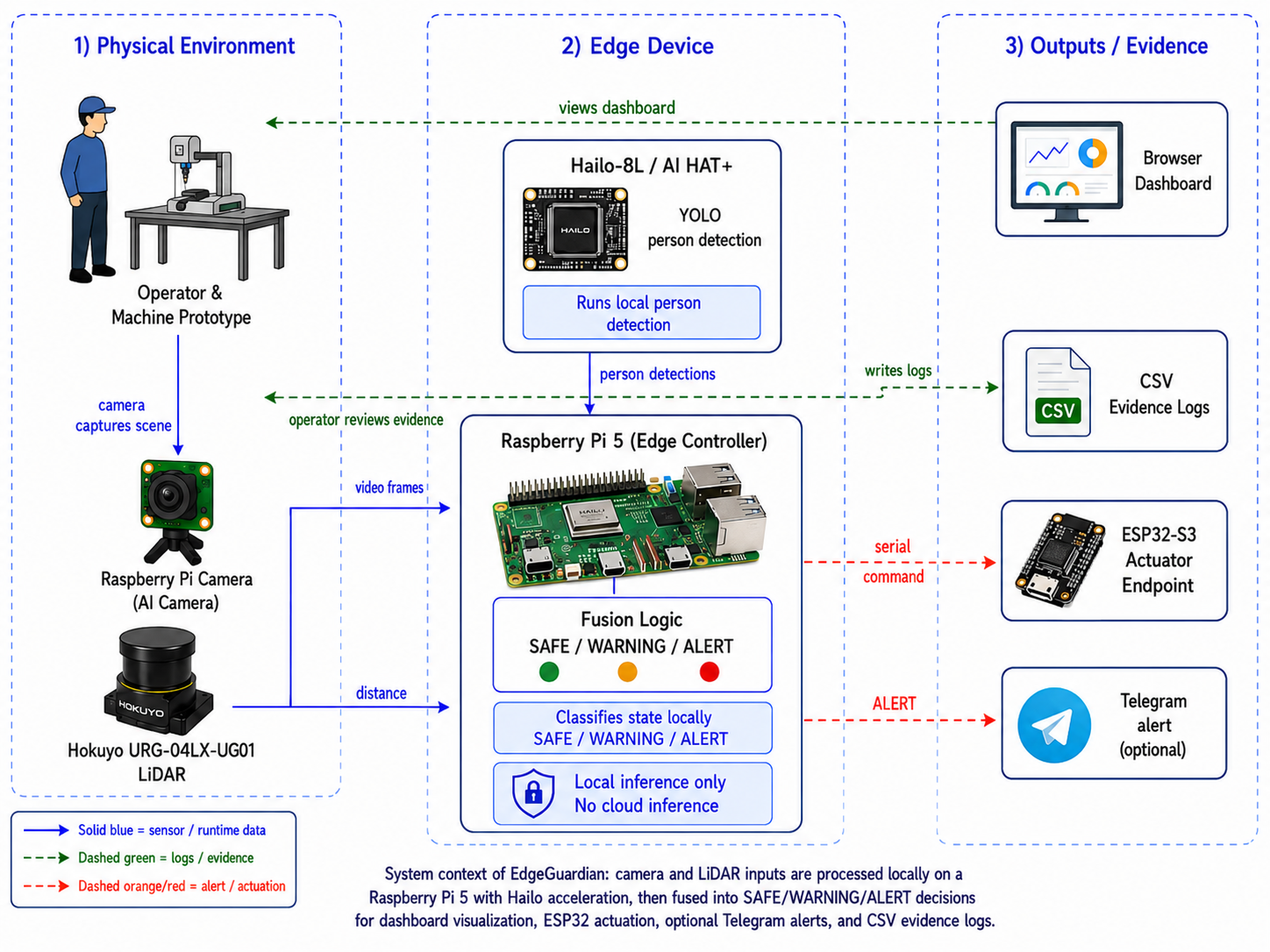
What the diagram shows
- Local-only inference path: camera frames and LiDAR distance stay on the Raspberry Pi runtime
- Separate outputs: dashboard, CSV logs, optional Telegram, and ESP32 actuation test
- Safety decision model is visible through SAFE/WARNING/ALERT state transitions
Container / Deployment View
Physical sensors feed a Raspberry Pi 5 runtime with Hailo-accelerated person detection, fusion logic, ESP32 serial actuation, dashboard visualization, optional Telegram alerts, and logs.
Open full diagram
Container / Deployment View
Physical sensors feed a Raspberry Pi 5 runtime with Hailo-accelerated person detection, fusion logic, ESP32 serial actuation, dashboard visualization, optional Telegram alerts, and logs.
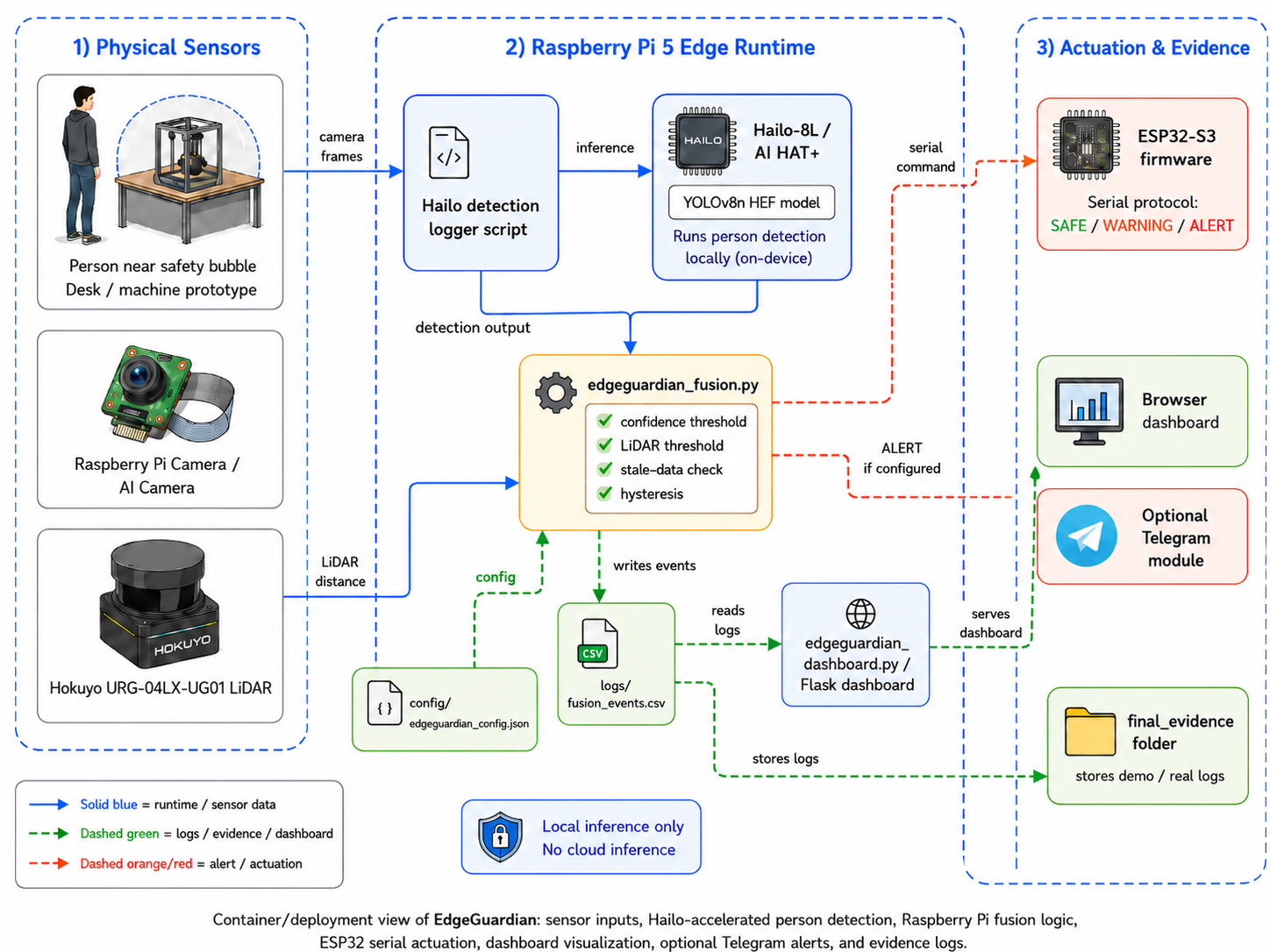
What the diagram shows
- Hailo detection output and LiDAR distance converge in the fusion script
- Hysteresis, stale-data checks, and thresholds sit before actuation or alerting
- Dashboard and final test artefacts make the demo inspectable after the run
Technical Decisions
- Hailo-8L accelerated YOLO person detection on Raspberry Pi 5
- Hokuyo LiDAR distance confirmation for camera-LiDAR sensor fusion
- SAFE/WARNING/ALERT state machine with hysteresis and stale-data checks
- ESP32-S3 firmware written in C/C++ for serial command handling and actuator integration
- Dark browser dashboard reading live CSV logs with last update age and event table
Validation
- Ran the local demo path with camera detection, LiDAR distance input, ESP32 serial commands and dashboard updates.
- Logged SAFE -> WARNING -> ALERT -> SAFE transitions during the demo.
- Kept final CSV and terminal logs for inspection after the run.
Results
Demonstrated end-to-end local edge AI safety monitoring with camera, LiDAR, embedded actuation, dashboard, and logs
30 FPS
Demo captured SAFE -> WARNING -> ALERT -> SAFE transitions at about 30 FPS
Real-mode logs captured continuous Raspberry Pi decisions from hardware inputs
Dashboard reason cards and CSV logs made the state transitions traceable during the demo
Complete stack
Hardware
Edge Software
Sensor Fusion
Monitoring & Outputs
Artifacts
Next technical step
Planned work
Broaden validation logs across more distance and lighting scenarios before any safety-critical use.